
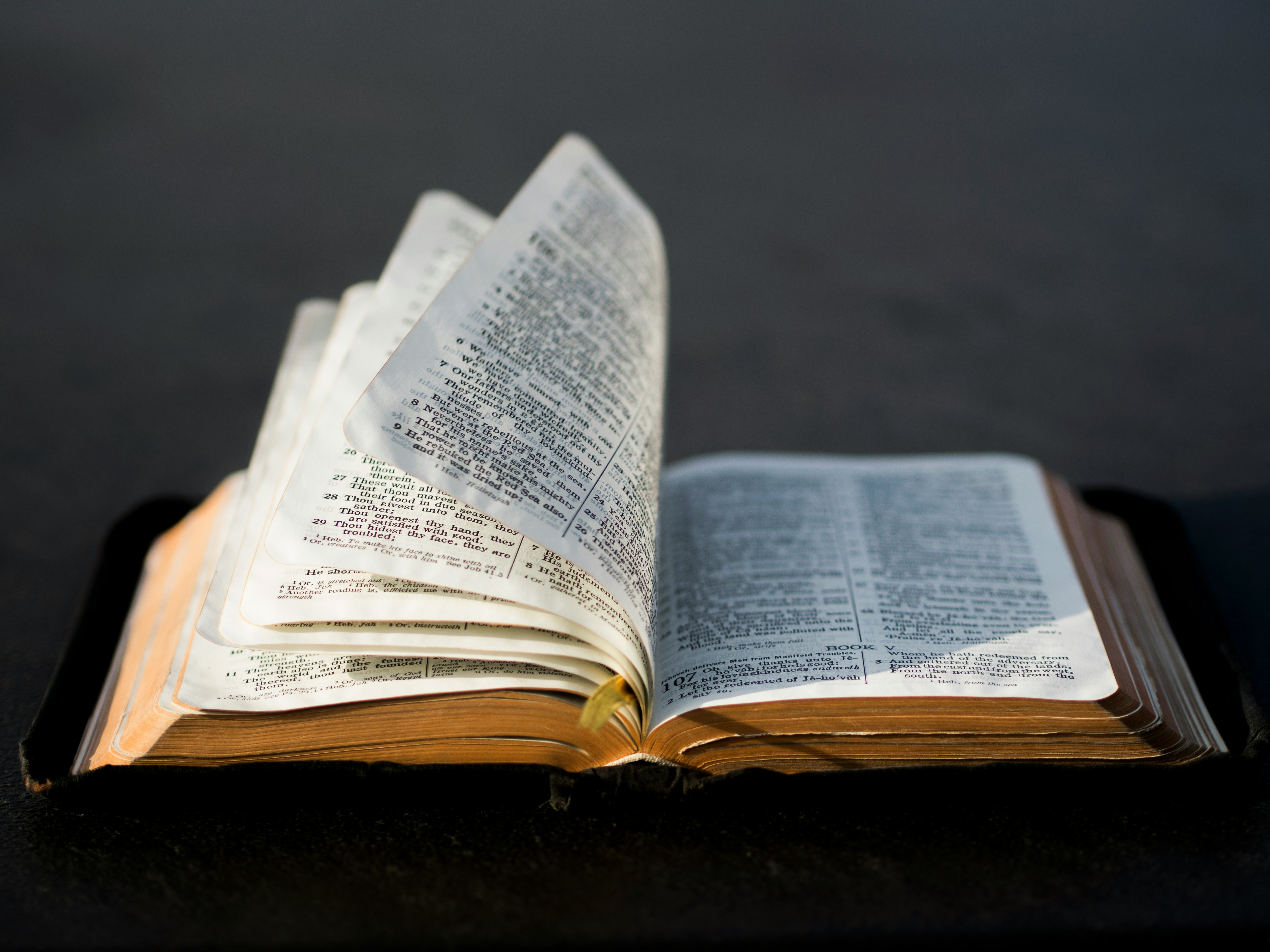
Most of my life, I’ve been taught that in order to have any kind of opinion and be “inside” the church, you have to begin at the place that says: “Everything in the Bible is true.” If you agree with that, we can have a conversation. You can have an opinion that matters.
But that’s such a funny, broad statement: Everything in the Bible is true. It’s as if you’re trying to make the Bible a multiplication table; Are all these facts correct? When you’re young, it seems as though it should be so cut and dry. So simple. But it’s not.
The Bible is a book made of many books, made of many chapters, made of many verses. It is also written in several genres or styles- history, poetry, proverb, law, geneology, instruction, prophecy, parable, narrative- probably more than that, but that’s what I can think of. Each style or genre has it’s own particular way of speaking. A geneology has a list of names, a poem has simile and hyperbole, prophecy can have literalism and metaphor. It’s complicated and diverse, beautiful and deep. And I would venture to call it True.
But is it all true?
A few years ago, I was in a ladies’ bible study in a local church, and the quarterly reader that was made by the denomination was going through a book of the Old Testament called Job. In the margins, one of the verses of the day was in bold, beautiful calligraphy. It was a statement about God- something about him being just or beyond understanding. I forget exactly, but it sounded good. I looked it up for context. (I think it might have been Job 11:7-9)
But as I read it, I thought- wait a minute.
Isn’t Job a story about Job having a long conversation with a few friends? And aren’t those friends literally arguing with him about God? And at the end, doesn’t God LITERALLY PUNISH THOSE FRIENDS for speaking what isn’t true??
So how can we take a verse out of one of their speeches and say, “This is FACT.” When actually, it’s one verse out of a long paragraph that one of these wrong friends were saying?
So what do we do with that? Can we say that an entire verse out of the bible can be not true? Because in context, it’s spoken by an untrustworthy person. But we also don’t just say that it’s definitely wrong, because there are many things spoken by Job’s friends that are true, half-true, wrong, or just misguided.
It actually takes wrestling, thoughtful consideration, and wisdom. It’s harder than just fact checking whether 7×7 is actually 49. It’s more nuanced than just saying “this verse is from the Bible, so it must be true.”
Now, let’s go to Ecclesiastes.
This book is called a book of wisdom, and it’s assumed to be written by Solomon, the wisest man who ever lived, who received his wisdom as a gift from God (1 Kings 3).
It would be really, really simple to open this book and conclude: “Everything in this book is wise, and therefore true, and therefore good.” But can we really say that?
Let’s think about Solomon himself.
Yes, he was the wisest man who ever lived. ( 1 Kings 3:12, 4:29) But does that mean everything he says is categorically True and good?
Let’s look at 1 Kings 11. The heading in the NIV is “Solomon’s Heart Turns from the Lord.” The narrative describes how despite the blessing of wisdom, wealth, honor, power, fame, and even the magnifcant calling of building the Temple, Solomon “loved many foreign women” and they turned his heart to other gods, and he did evil in the sight of the Lord, and did not fully follow the Lord. And then it says that the Lord became angry with Solomon, and decided to tear the kingdom of Israel away from him.
Now, let’s talk about this book- Ecclesiastes. The one supposedly written by Solomon, who is both wise- and foolish. Wise as a gift from God, foolish by his own choice. What do we do with an entire book that he wrote? Do we just blanket-statement say, “It’s in the Bible, so it’s true, so I believe it?”
Or do we look at it with a discerning, measured, humble heart that says, “My, but this takes wisdom to understand, and the Holy Spirit to discern?”
I think the first, simple approach, is less correct. And the second, more difficult, more risky- is the wiser.
I think we take this book, like every book, and say- I believe that I can find the Truth in these Scriptures. But not because they are simple and easy, because every verse is True and Simple, but because the God of the Universe, the One who is the True Author, wants me to find Him. And when I read this book with the understanding that it’s a deep, complicated, beautiful book that leads me to The Way, the Truth, and the Life.
With that, I have a small goal to go through the book of Ecclesiastes over the next little while. It’s the “book of wisdom” and I really believe that the world needs a bit more wisdom. At least, I do. If you want to follow along with me, just click subscribe to emails and you’ll get updates in your inbox. Or, follow me on facebook and I’ll try to keep it posted there!
I’d love to hear your comments and conversation about what you think. And if you know someone who might like to do this, I’d love if you’d share it.
Love,
Brianna

 briannasiegrist.com
I will be studying Lamentations and Ecclesiastes over the next few weeks with a group. That’s funny that you are too!
It’s been an interesting journey studying in seminary and seeing what ideologies and ideas different theologians have placed on the Bible that the Bible doesn’t even place on itself. But then we just go around repeating what these men came up with like it’s gospel. Like the Bible doesn’t say that it’s all True. It says that it’s profitable. It doesn’t say “sola scriptura” it says to stand firm in tradition.
LikeLiked by 1 person